- Call us 01444 237070

-
- Back
- Used Cameras
- Used Accessories
- Used Lenses
- Back
- Used Canon Lenses
- Used Nikon Lenses
- Used Fujifilm Lenses
- Used Sony Lenses
- Used Micro 4/3rds Lenses
- Used Leica Lenses
- Used Panasonic Lenses
- Used Pentax Lenses
- Used Samyang Lenses
- Used Sigma Lenses
- Used Tamron Lenses
- Used Tokina Lenses
- Used Voigtlander Lenses
- Used Zeiss Lenses
- Used Hasselblad Lenses
- Used Video
- Used Film Equipment
- Used Stock Alert
- Used Blank Test
- Sell or Part Exchange
- Used Clearance
- Recently Added Used Equipment
- Park Picks
- Faulty
- Trade-In
- Blog
- New in
- Call us
- Contact us
- Stores
- Sign in
product
BUYING-08
Call us: 01444 237070
Search terms
Brands
Category
Products
[[{name}]]
[[{attributes.Price}]]
- Categories
- Tips & Inspiration
- Reviews
- News
- Events
- Features
- Buying Guides
- Competitions
Best Canon Camera
Choosing a Canon in 2026 comes down to matching a body to how you like to or want to shoot, not hunting for the best badge on the shelf. Several models share really impressive features, such as autofocus, quick continuous burst and great video performance, so the real differences come down to sensor size, handling and where each is designed to excel.
This guide walks through the options that make sense for different kinds of photographers and creators, whether you're picking up your first interchangeable-lens body or on the lookout for something more specialised. Instead of steering you toward the flagship, we'll show you where each model performs best, when the extra spend is worth it, and when that money is better saved for a lens instead.

The Range at a Glance
Seven bodies, seven different jobs. Some are built to be picked up without a second thought, others reward photographers who already know exactly what they need from a sensor. The table below cuts through the spec sheets and shows where each model actually fits, so you can narrow things down before reading further.
| Model | Sensor | Resolution | Stabilisation | Continuous Shooting | Best Suited To |
|---|---|---|---|---|---|
| EOS R50 | APS-C | 24.2MP | Lens IS | Up to 15fps | First interchangeable-lens body, holidays and day to day shooting |
| EOS R10 | APS-C | 24.2MP | Lens IS | Up to 23fps | Stepping up from a beginner kit, family life and casual action |
| EOS R7 | APS-C | 32.5MP | IBIS | Up to 30fps | Birds, wildlife and anything too far away to walk closer to |
| EOS R8 Mark II | Full-frame | 24.2MP | IBIS | Up to 40fps | A first full-frame body without the bulk, equally at home shooting stills or video |
| EOS R6 Mark III | Full-frame | 32.5MP | IBIS | Up to 40fps | Enthusiasts who shoot a bit of everything and want one body that keeps up |
| EOS R5 Mark II | Full-frame | 45MP | IBIS | Up to 30fps | Studio, landscape and editorial work where detail and speed both matter |
| EOS R1 | Full-frame | 24.2MP | IBIS | Up to 40fps | Pitchside press work and pro sport, where a missed frame isn't an option |
I'm a Beginner, Where Should I Start?
If you're a beginner coming from a phone or a point-and-shoot, the EOS R50 is a typical landing spot. It's light enough to be in a bag without you noticing, the menus don't need a manual to decode, and the autofocus is really clever, recognising faces, pets and moving subjects so you can spend your energy learning how to frame a shot rather than worrying about focus. It's not a toy though. Once you're ready, manual modes and a growing lens collection give you room to grow and really take off.
If you already suspect this is going to turn into more than a passing interest, the R10 earns the higher price tag. The grip sits better in the hand, the dials give you faster access to settings you'll want to change mid shoot, and the quicker burst rate means a football match or a dog at full sprint is far less likely to end in blur. It's still small enough to disappear into a daypack for a weekend away.
Both share the same RF mount, so any lens you buy travels with you if you upgrade later. Full-frame lenses fit too, though for a first kit the smaller, lighter crop format RF-S options are usually a more sensible match, both for your shoulders and your wallet.
The choice mostly comes down to what matters most on day one. Pick the R50 if you want the most simple, compact and easy on the budget. Lean towards the R10 if you're expecting fast subjects and want a bit more camera that you can extend your skills with and grow into sooner rather than later. Our Canon EOS R50 review takes a closer look at the smaller option if that's where you're leaning.

Best for Wildlife and Action
There's a persistent myth that serious wildlife photography means saving up for full-frame. The EOS R7 definitely argues otherwise. The APS-C sensor reduces the field of view from any given lens, so a 400mm acts more like a 640mm would on full-frame, which is exactly what you want when a bird has no plans to let you get closer!
It's not just about reach though. There's enough resolution to crop into a shot when you need to, the burst rate keeps up when a subject bolts, and subject detection does a good job of grabbing focus on something that might only be in frame for a couple of seconds before vanishing back into the undergrowth. In-body stabilisation makes a difference too, especially when handholding a long lens for hours at a time.
We reviewed it here in our Canon R7 review for photography, which goes into more detail about the smaller, lighter body at a lower price than the full-frame options.
That's not to say there's no reason to go higher up the range. Any professional, or someone who regularly shoots in poor light, or maybe needs the more advanced tracking in the R5 Mark II or R1, will find good reasons to spend more. But for enthusiasts who spend their weekends with a long lens pointed at birds, deer, aircraft or a match, the R7 lands as a very capable option.

Moving Up to Full-Frame
A bigger sensor isn't a blanket improvement, as the R7 shows, but it does change what's possible. Shallower depth of field comes more easily at a given aperture, high ISO images can hold together better in low light, and RF lenses hit their widest angles without the crop factor. Whether that matters to you depends entirely on what you’re shooting.
The EOS R8 Mark II gets you to full-frame without the usual size or cost of many other bodies. At well under 500g, it is similar to an APS-C camera, which makes it a sensible pick for travel, street and anyone who splits time between stills and video without wanting a big, heavy system.
The R6 Mark III is for people who shoot content frequently rather than occasionally. The higher resolution gives you more pixels to start out with, the extra speed handles anything from kids on the field to club-level sport, and the deeper grip holds firm during a full day's shooting in a way the R8 II cannot quite match. If nothing on this list feels like your one specialist subject and you'd rather buy a camera you won't outgrow in two years, this is the one.
The R5 Mark II gives you even more resolution, and 45 megapixels means real room to crop, produce large prints without upscaling, and capture enough detail for commercial or landscape photography. The AF and shooting speed keep pace with the resolution too, so you're not trading one for the other. It’s a second-generation thoroughbred hybrid and a great choice for video too.
For a closer look at the middle ground, our Canon R6 Mark III review explores how it performs as a hybrid body.

Photography, Hybrid or Video-First?
The stills-versus-video divide is mostly gone. Every camera in Canon’s RF mount range shoots respectable 4K, and the R6 Mark III and R5 Mark II are proper hybrids, capable of 7K and 8K RAW footage respectively without swapping kit.
What matters is how much video shapes your workflow. Shoot mostly stills with the odd reel or behind-the-scenes clip, and any EOS R body has you covered. Once video becomes more prominent, priorities shift to recording formats, overheating limits, audio inputs and how long footage can run before the camera stops, which are more important than burst rate or a viewfinder.
That's a gap which the EOS R50 V fills perfectly. Same interchangeable-lens system as the R50, but the controls and menus are aimed at recording more than shooting stills. The PowerShot V1 trades interchangeable lenses for a fixed zoom in a really small body, which could be useful for anyone who doesn’t want the hassle of switching lenses but still wants great video.
The next step up is Cinema EOS, which is made for productions where the camera slots into a video workflow rather than doubling as a stills camera. At that point you're choosing based on codecs, monitoring and rigging, which is more advanced than most of the EOS range.
Most hybrid creators won't need to pick a side. Today's hybrid bodies are so capable that the line barely matters until you're working professionally, and will certainly cater to the most popular YouTube channels and more.

Choosing the Right Lens
The lens shapes your results more than the body does. A cheaper camera with the right glass usually beats a flagship paired with whatever lens was left over.
On the R50, R10 or R7, RF-S lenses keep the kit light and the cost down. Any RF lens fits too, which matters for wildlife, where a full-frame telephoto still makes sense on an APS-C body thanks to the extra reach. Our Canon RF 75-300mm F4-5.6 lens review is one example of an accessible telephoto option for getting closer to distant subjects.
Full-frame bodies unlock the whole RF range at its true field of view, from wide zooms to fast primes and long telephotos. Worth deciding what you actually shoot before you buy: a landscape photographer, a wildlife shooter and a wedding photographer could pick the identical body and end up with three unrecognisable kits.
Buy for the subject, and you won't end up with glass that never leaves the bag.
If you've narrowed down what suits you, explore our Canon mirrorless cameras to compare the latest bodies and lens kits.
Frequently Asked Questions
Should I buy a DSLR or mirrorless camera in 2026?
Canon hasn't released a new DSLR since 2020, with development now focused on its mirrorless system. Used models can still represent good value, particularly if you already own compatible lenses, but starting with RF gives you considerably more room to grow.
Is the EOS M system still worth buying?
EOS M has been discontinued, so although bodies and lenses are available secondhand, no new models are being developed. A cheap used kit can still take great pictures, but RF makes considerably more sense if you're buying with future upgrades in mind.
Can I use my old EF lenses on a new RF body?
Yes. EF and EF-S lenses can be used with the EF-EOS R mount adapter, which makes upgrading much easier if you've already built up a collection. Just remember that EF-S models use a cropped image area on a full-frame body.
How long does the battery last, and do I need a spare?
It varies considerably by model and how you shoot. Video recording, long bursts, reviewing images and heavy use of the screen or viewfinder all consume more power. A spare is well worth considering for travel, events or any full day away from a charger.
Do I need a full-frame camera to sell my photos professionally?
No. APS-C equipment is used professionally too, and the finished image is far more important than sensor size alone. A larger sensor can bring useful advantages in low light and when controlling depth of field, but it isn't a requirement for producing professional work.
Does a Canon camera come with a lens?
Sometimes. Bodies are commonly sold either on their own or as a kit, with the latter including a lens to get you started. Check the individual product name and what's included when comparing prices, as a cheaper listing may simply be body-only.
Share this post:
By Park Cameras on 01/08/2022
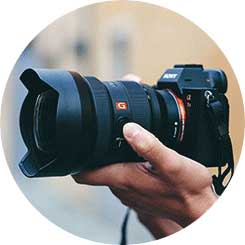
Trade in your old equipment
Fast and easy trade in service ensures your old gear is collected efficiently and you are paid quickly! It's very simple to trade in your unwanted photography gear. Just head over to our dedicated Sell or Part Exchange page, fill out the details, and we'll get back to you with an offer for your old gear. Take the cash, or put it towards the cost of your new gear. It's up to you! Find out more
sign up to the newsletter
Keep up to date on the latest photography news, events and offers. Sign up now